In the 1960s, the Black Supplementary School Movement opened voluntary Saturday schools to address the gaps in an education system that were leaving Black children behind. Sixty years later, more than 3,000 grassroots supplementary schools are still supporting minoritised children across the UK. In Leicester, teacher Julie Walters-Nisbett says the community’s Phoenix Agenda Supplementary School is as relevant as ever.
Tucked behind Leicester railway station is an office block where the main splash of colour is a sign spelling in red, green and yellow, ‘African Caribbean Centre’. On a grey Saturday morning in spring, the silvery music of steel pans from a children’s class floats through the windows.
Upstairs, in a large conference room lined with flags of countries from Ghana to Jamaica to Somalia, local science teacher Julie Walters-Nisbett strides in sparkly silver sliders and flowing black trousers down a line of tables.
 A scientific display on one table features a pair of sheep’s lungs next to a human torso anatomy model. Walters-Nisbett pauses to wrestle a doll’s head, known as “Smoking Annie”, onto a tube which can collect tar from a cigarette. The following table is filled with laminated pictures of Black pioneers in science and medicine.
On the other side of the room, 12-year-old Lucio is frowning over his laptop. He needs to do a risk assessment for the chromatography experiment he will demonstrate later. He explains that, in the process of separating the different colours from a black pen, the glass beaker could potentially explode.
Fortunately, the beaker remains intact as his younger sister, Lumi, watches a dot of ink travel up paper dipped in a clear liquid, separating into hints of purple and blue.
“It’s a heart!” she exclaims, grinning.
The two children are students at the Phoenix Agenda Supplementary School (PASS), co-founded by Walters-Nisbett, alongside teacher and researcher Dr Camille London-Miyo and former local councillor George Cole. The siblings are helping Walters-Nisbett out with a STEM day she’s putting on for the community as part of National STEM Week, focusing on inspiring an interest in science, coding and healthier living habits.
Walters-Nisbett helps run PASS for children between the ages of around 7 and 16 alongside the Principal, London-Miyo, who oversees English teaching for the school, while also advocating for racial literacy and more diverse curriculums in schools. They’ve seen around 50 students come through the school in the 6 years it’s been running. Walters-Nisbett also juggles PASS with other commitments, teaching in a college and working for Leicester’s National Education Union. On the weekly evening she teaches online classes for PASS, she starts the day at 5.45am and then proceeds to work a 13-hour day.
Many of the issues she saw Black children encountering when she started teaching 25 years ago are still present today: from children being stereotyped as troublemakers, to the outcomes of Black Caribbean children lagging those of their peers in secondary school.
“Most Black teachers, most ethnic minority teachers went into teaching to support our own,” she says. “Unfortunately, our young people are still telling us that they’re experiencing issues like colourism, a lack of a curriculum that represents them.”
The Supplementary School Movement
PASS is part of a wider educational movement started in the 1960s, when people were coming in increasing numbers from what were then British colonies in the Caribbean as part of the Windrush generation, encouraged and invited by the British government to help rebuild the UK economy after the Second World War.
But when children arrived in schools, they often met obstacles to their educational progress, including prejudices that they were intellectually inferior. One leaked report by Haringey Council from 1969 said of the Caribbean pupils “that their I.Q.s work out below their English contemporaries. Thus academic standards will be lower in schools where they form a large group.”
Hundreds of Black pupils were labelled as “educationally subnormal” (a term derived from the 1944 Education Act), and sent to schools for pupils who were judged to have lower intelligence: one past attendee remembered his school didn’t even have a curriculum.
In response, parents, community activists and teachers from the Caribbean set up ‘supplementary schools’, usually running on Saturdays and weekday evenings, trying to make up for the gaps in their children’s education.

‘I was taught by Black teachers’
Walters-Nisbett initially had no plans to become a teacher. She was a trainee accountant in the NHS when the charity The Windsor Fellowship put out a call to get more Black heritage teachers into UK schools because the drop-out rate among ethnic minorities in teacher training was so high.
Walters-Nisbett went into schools on the weekends, learning about planning and marking, and qualified as a teacher in around 2000.
By that time, although decades had passed since the term “educationally subnormal” was in official usage, the results of Black children were trailing those of their peers. A 1996 report had found that Black children in Leicestershire were permanently excluded at five times the rate of White children. The report was written up by the Times Educational Supplement with the headline, “Blacks blame racism for failure”.
In fact, the report made a list of reasons why Black children may struggle in schools, including the lack of Black teaching staff across the country. Almost 26 years after qualifying, Walters-Nisbett still holds firm to the importance of Black children being taught by Black educators.
“You can’t be what you can’t see,” she says.
Growing up in St Kitts until she was 16, “I was taught by Black teachers, seeing Black lawyers, seeing Black doctors – you understand what I’m saying. But unfortunately for some young people, they’ve never had that imagery.”
‘Everybody knows everybody’
After moving to London for her A-Levels, Walters-Nisbett remembers being bewildered by being one of the few Black students taking exams at that level in her school. Moving to Leicester for university was another shock to the system.
“It was like stepping back in time,” she says, where nothing was open on a Sunday and everything was “quieter, calmer – and everybody knows everybody, don’t they?”
At the STEM day in the African Caribbean centre, a man hurries in and out of the room, talking in a low voice on the phone while Nas and Wizkid play from the speakers. He is familiar to many in the room for several reasons.
For one, he is the grandfather of the children doing the chromatography experiment; for another, his face is displayed in a celebration of the Windrush generation at Leicester railway station with the title “Councillor George Cole, Leicester’s First Black Lord Mayor 2022, Chairman of the African Heritage Alliance”. When asked about the display, Cole jokes that it’s his twin.
Cole was one of the key reasons why PASS came into being in the first place. When he first became a councillor in 2011, he saw that the performance of Black children had been below Leicester’s average for decades while Leicester schools were also lagging behind the national average, “which suggested that they certainly weren’t doing too well,” he says. He helped commission a report diving into why some ethnic groups were behind in schools.
The 2019 report showed a mixed picture. When the children were 16 and taking their GCSEs, Black African children outperformed their peers, but the results of Black Caribbean children were nine points below the local average. The figures were similar across England, and remain so today. At GCSE-level, Black Caribbean children and Mixed children who are White and Caribbean are two of the worst-scoring groups in the country.
When the report revealed the extent to which Black Caribbean children’s grades lagged their peers, Cole thought, “this is quite an indictment…there’s no provision in the community for these kids who aren’t doing too well – and so PASS came about.”
Cole moved to Leicester from Jamaica as part of the Windrush generation in 1964, and saw his parents encounter systemic racism, such as the famous ‘no Irish, no blacks, no dogs’ signs when looking for accommodation.
Today, “nothing has changed,” he says, pointing to the ‘stupidness’ of Reform and the government adopting its anti-immigrant rhetoric.
“Instead of [racism] being overt, it’s now covert, but the issues are still there,” he says. “My son was complaining about the things that I was complaining about when I was at school. My fear is that my grandchildren will be complaining about the same things I was.”
Educational enrichment to address an employment crisis
Today, nobody knows how many supplementary schools are still running: the government doesn’t collect any data on the institutions.
According to one estimate, there are at least 3,000 across the country, usually running on weekends and evenings and giving the children, who are largely from minoritised and under-privileged backgrounds, the time and space to access opportunities ranging from a focus on STEM subjects to cultural outings.
This focus on opportunities which children might not find in school is particularly important to Walters-Nisbett. “A lot of our students are transported to school on a minibus and back home on a minibus, and don’t ever kind of see the world outside of school and home,” she says. “It’s about helping our parents to understand that, yes, they do need these opportunities to take part in what we call enrichment, you know, go to the panto, go to the netball club.”
The STEM day is one example of an enrichment opportunity, but PASS is addressing several anxieties which have been brewing around young people in the UK, which are now threatening to become full-blown crises.
Read more: “If you can see it, you can be it”: The impact of Black role models and Black creative spaces
For one, the proportion of young people who are not in education, employment or training, has spiked since 2021 – so much so that in March 2026, the government announced it would pay businesses thousands of pounds for every young person they employed who’d been looking for work for more than 6 months. That’s despite the fact that some STEM industries are struggling to recruit enough qualified staff. In engineering, for example more than three quarters of employers are struggling to fill vacancies for key roles.
Encouraging physical activity and community-building
The STEM day is also addressing issues that are more difficult to measure than employment levels. Walters-Nisbett is worried that “our young people are getting less and less active with the rise of increased screen time,” and begins the day reminding the participants that Leicester has one of the worst rates of type 2 diabetes in the country – a condition which Black people are particularly vulnerable to.
She kicks off the day with an Afrikan yoga class, followed by family Zumba. A trio of teenage girls, who had been poking at the lungs with black gloves, are commanded to join the yoga and cannot be persuaded to swing their arms around more than half-heartedly to the background music of drums, but balance well in a series of tree poses.
In the corner, bent over another laptop, is a 17-year-old alumnus of PASS, who is about to give a presentation about how she got a place to study with the National Space Academy, based at the National Space Centre in Leicester, taking A-Level and BTEC classes. When asked what she’d say to children who don’t like science, she concedes she didn’t always enjoy the subject, but “it’s hard not to like the whole of science…everything kind of goes down to science.”
Her mother, Leona White-Simmonds, says that although her two daughters were always good students, they weren’t initially thrilled about spending their Saturdays in school with PASS. But as a friend of Walters-Nisbett and someone who’s studied race and ethnic studies herself, she knew that the supplementary school system would be good for her children.
“They want to build a village,” she says. “Having something like Phoenix, it recognises that there are barriers, there are inequalities, there are all of these things, and it doesn’t make excuses. But it recognises them.”
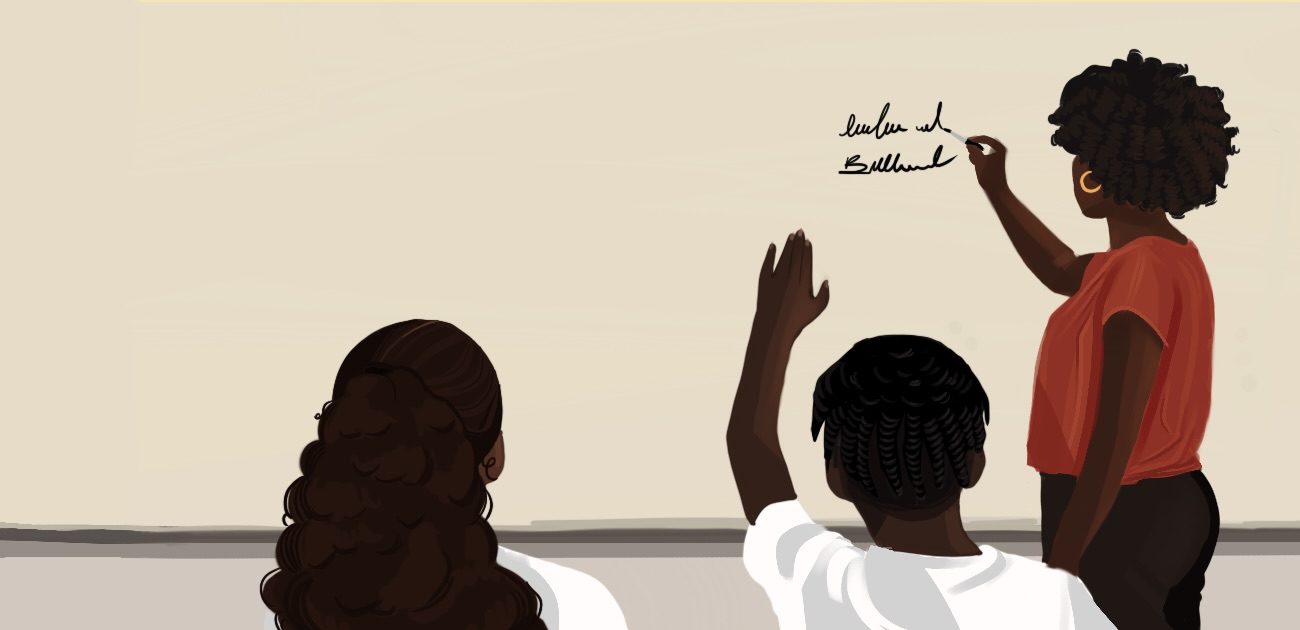
All illustrations by Lacuna artist Wong Yan Yee.
Read more: