Angola has one of the highest fertility rates in the world, and in some rural regions the rate of teen pregnancies is more than double that in urban areas. In the Moxico region of Angola, teenagers, young mothers, nurses and NGO workers share their stories.
A crowd of pregnant women gathers at the still-closed gates of the Alto Luena health centre in the Moxico region of Angola. It is 8am and the centre should be open by now. One of these women, Jenetta, has taken a whole day to get here. She doesn’t know how long she has been waiting.
“I leave the fields, walk to a meeting point and catch a ride. I arrive whenever I can,” she says, in a mixture of Chokwe – a local language – and Portuguese. She dedicates her time to farming, growing yucca and corn. Jenetta is 32 years old and this is her fifth pregnancy.
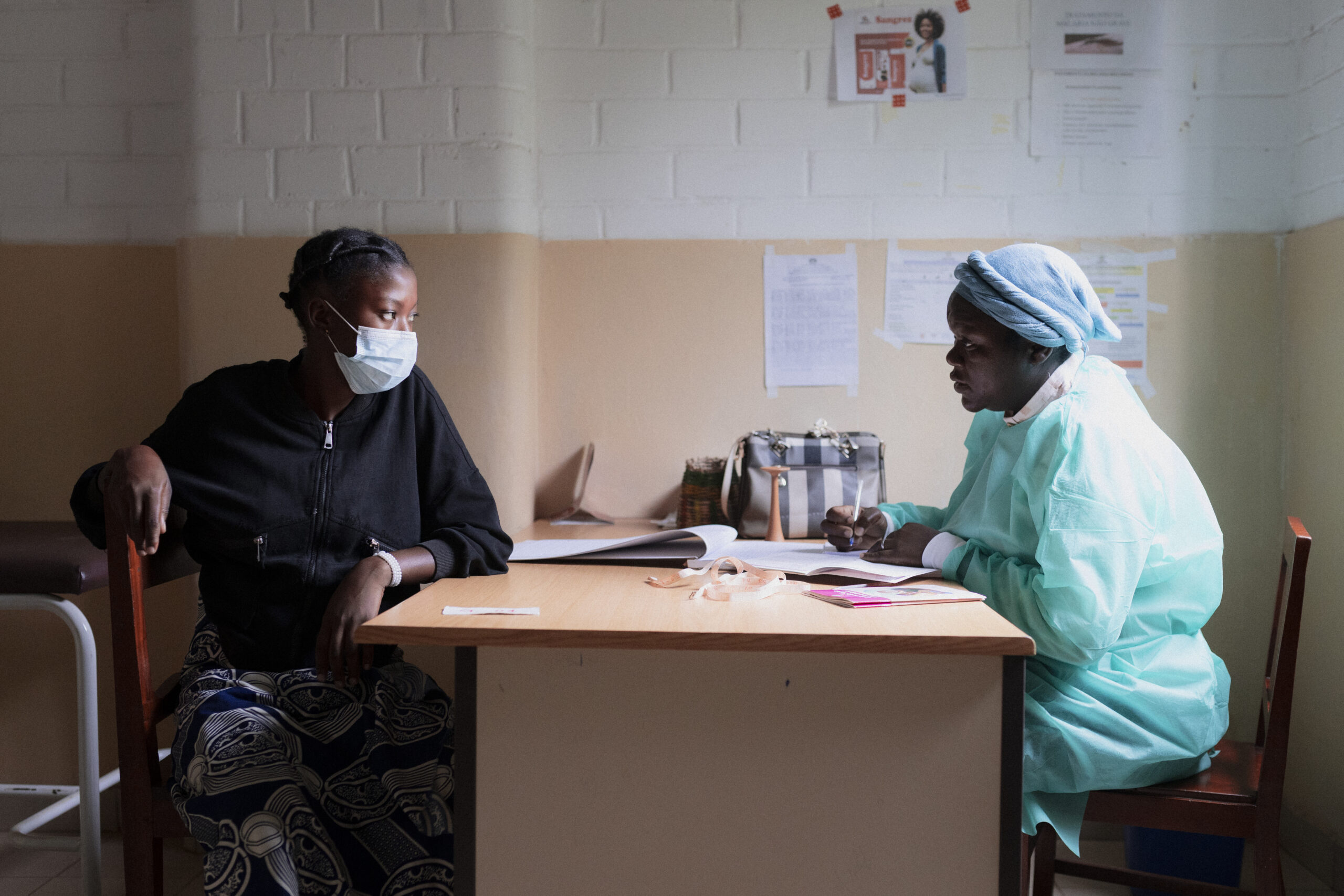
A young woman attends one of the pregnancy consultations at the Alto Luena health centre. During these consultations, patients are monitored and prescribed medicines and vitamins at a reduced price. Photo by Macarena Pérez Herrera
In the midst of the hustle and bustle, the health centre finally opens. Luzia, a nurse, hands out the appointment numbers one by one. They are handwritten on the back of some folic acid supplement boxes.
Thirty-two-year-old Jenetta is an exception on this day, when most of the women are barely over 25.
One of the first to be called is Carla, aged 17. She is almost eight months pregnant and weighs 40kg. During the consultation, she can barely speak. She has a fever and feels nauseous. A rapid test reveals the reason for her illness: Carla has malaria. After the diagnosis, she vomits.
“Early pregnancy is one of the major problems in this neighbourhood. The average age ranges from 14 to 17,” explains Jilza, a nurse at the centre, who cites “low levels of schooling” and “cultural norms” as the main factors affecting women in Angola, coupled with a lack of information on family planning. “They don’t know how to avoid pregnancy and, on the other hand, [here] family planning is a sin because you’re killing,” she adds.
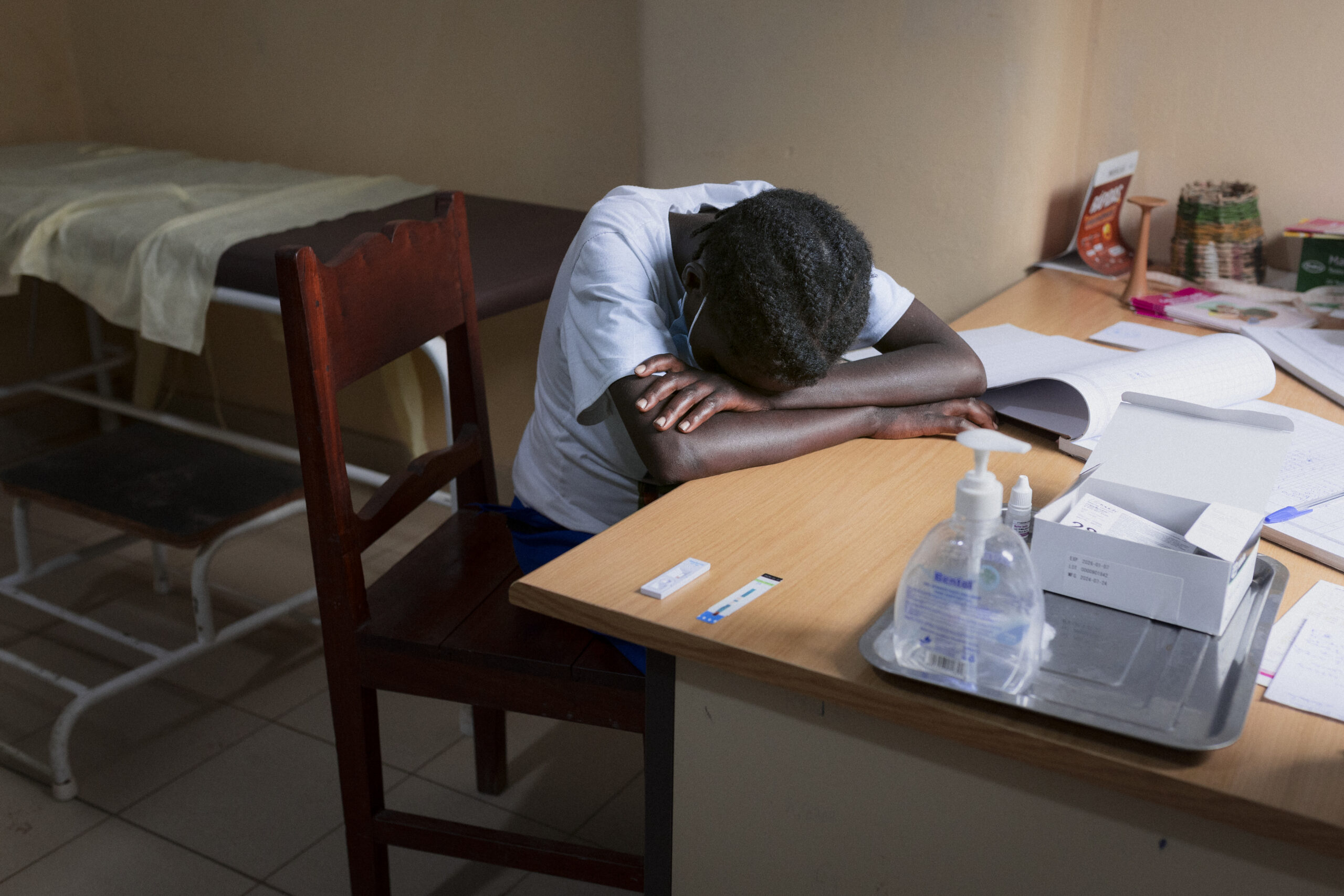
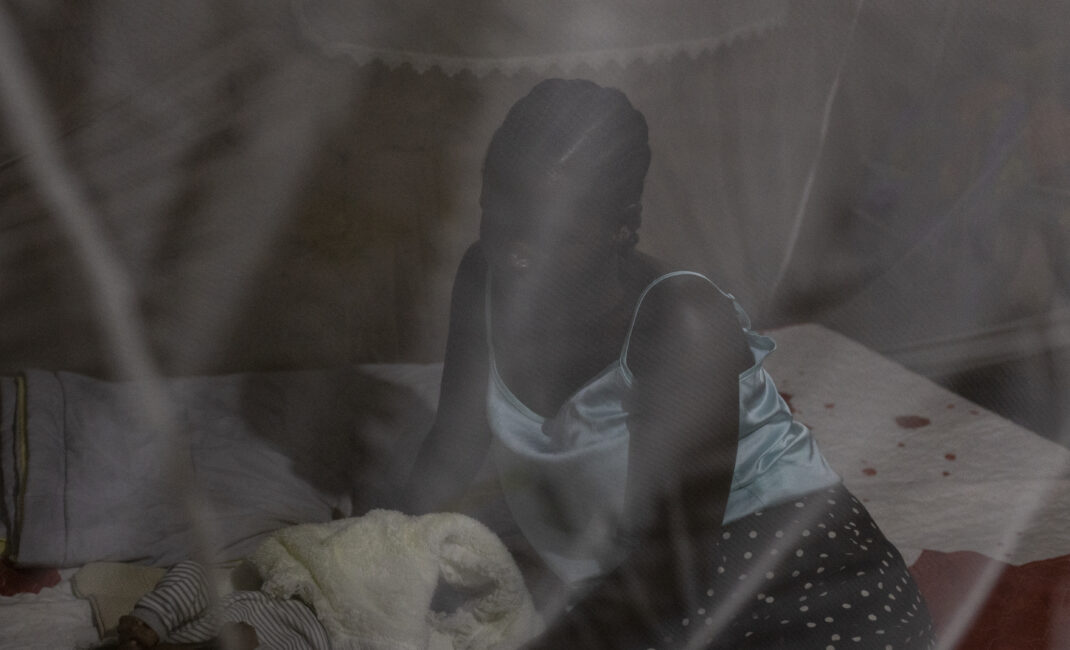
C., who is seven months pregnant and weighs just over 40 kilos, rests on the table after being tested for malaria and HIV when she showed symptoms during her consultation. The rapid tests come back positive for malaria and negative for HIV. Photo by Macarena Pérez Herrera
“Being a mother isn’t easy…”
In a rural area such as Luena, around 195 out of every 1,000 teenagers aged between 15 and 19 become pregnant, according to the Multiple Indicator and Health Survey. In urban areas, the rate for the same group is 88 births.
Nationwide, 35% of teenage girls have already become sexually active by this age, and 64% of the population is under 25. In short, Angola has one of the highest fertility rates in the world (4.8 children per woman). Breaking this down by region, the average fertility rate in rural areas is 6.9 children per woman, whilst in urban areas it is 3.8 children per woman.
These early pregnancies lead to young women abandoning their studies, which reduces their chances of accessing higher education and qualified jobs.
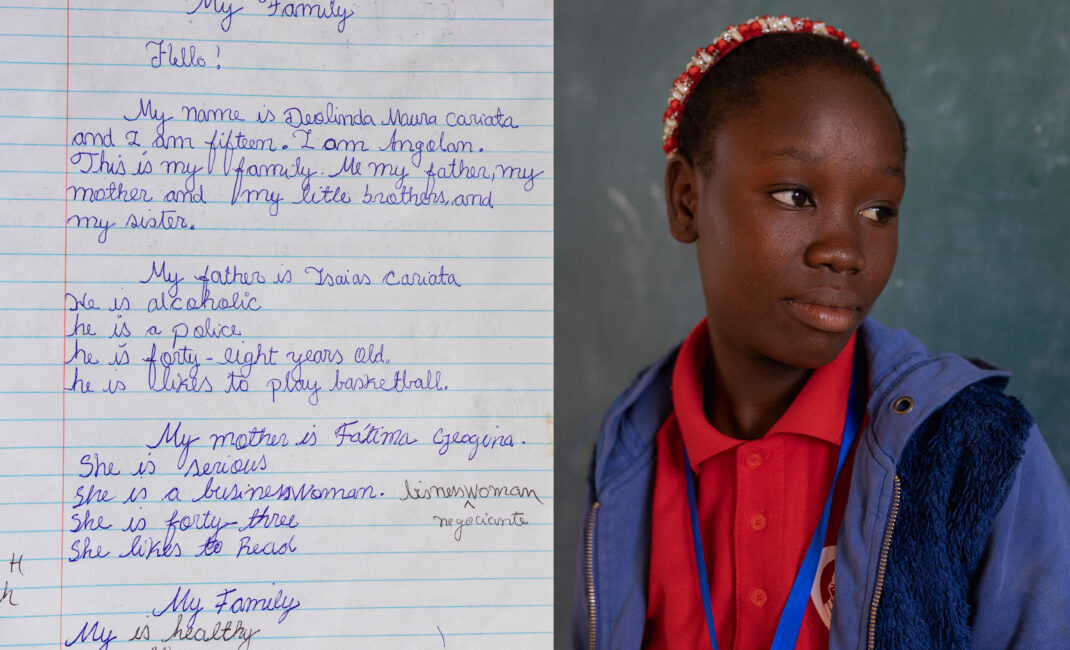
This was the case for Deolinda, who became pregnant in March 2024 at the age of 17. “It was unwanted”, she says. She speaks calmly, sitting on one of the benches in the playground of her school, the Sagrado Coraçao School in Luena, beneath a mango tree whose fruit is now ripe.
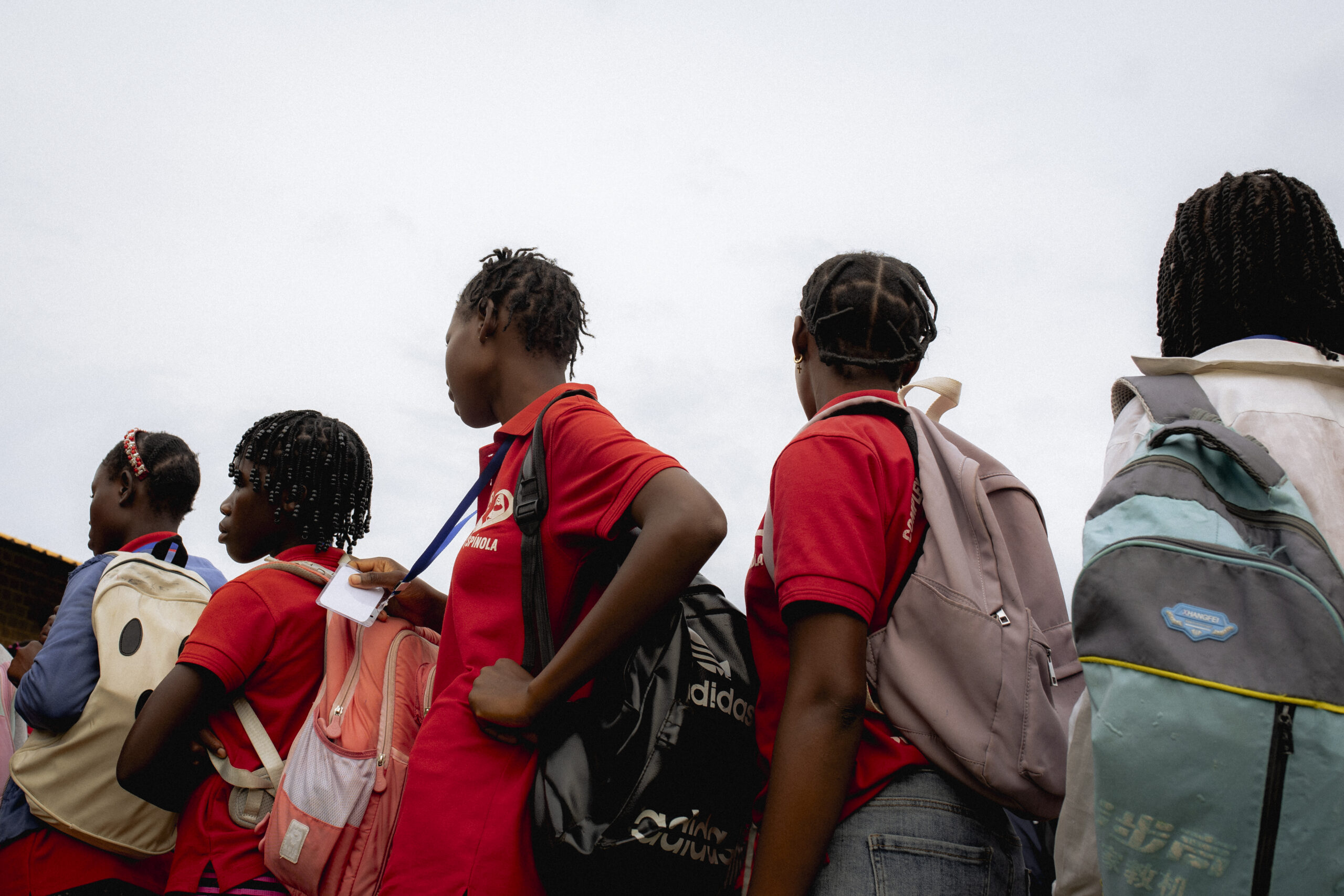
A group of girls, including Deolinda, line up before classes begin. Photo by Macarena Pérez Herrera
The following September, she was able to resume her studies, starting the year she had left off from the very beginning. “I stopped having so many friends when I got pregnant. I feel like that’s when all the fun ended for me. Now I have to look after my little girl and think about what she’s going to eat. But I decided to go back to class because I didn’t want to be a woman who gave up on her studies. I made a mistake the first time and I don’t want to make a second one,” she says.
The bell rings to signal the end of the lesson, but Deolinda doesn’t want to leave without leaving one last message: “To the girls my age who are starting to date, I would tell them to use condoms. Being a mother isn’t easy. And there are risks such as trauma or infant and maternal mortality. My mental health was completely ruined,” she concludes, highlighting her “sadness” at having failed all her subjects the previous year.
In the background, 16-year-old Bem-vindo watches the scene unfold. He waits curiously for Deolinda to finish so he can join in the conversation.
“I know there are contraceptive methods like the pill, the implant or condoms. But I had no idea about any of this; I only learnt about it in sex education class when I was 15,” he declares.
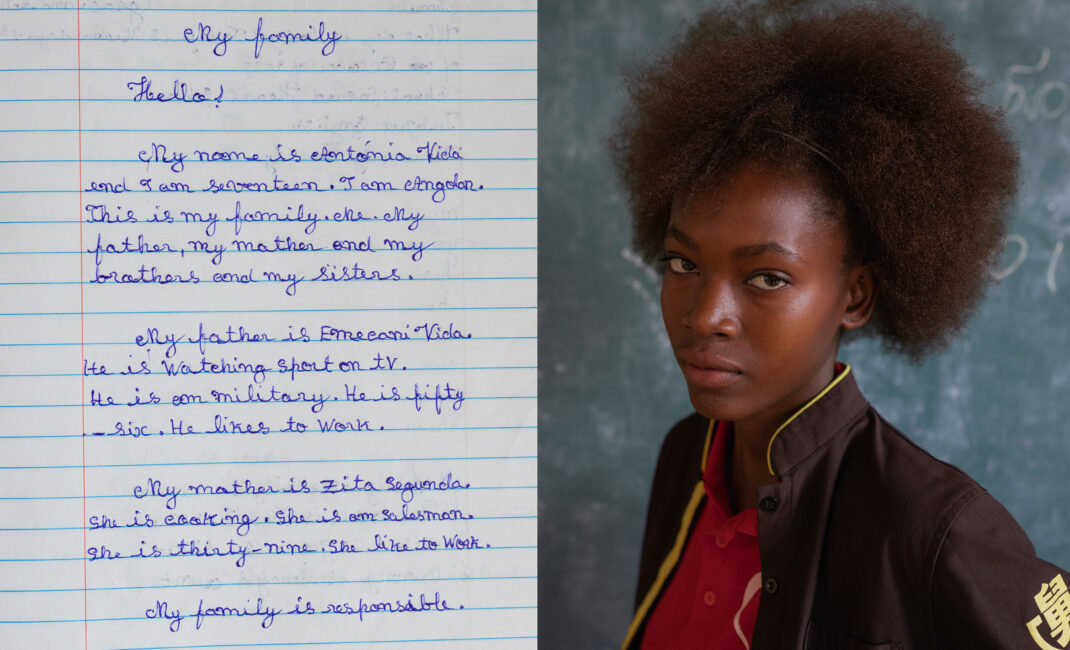
For Deolinda, as for so many others, these lessons came too late. Her friend Antónia, who also became a mother the previous year at the age of 17, curses herself for it: “If I’d known how it all worked, none of this would have happened. I just wanted to experiment. I got pregnant on my first time.”
Lúcia, from the same school, also gave birth around the same time and at the same age. But her baby died. “He only lived for a day. But I’m fine. It wasn’t difficult,” she says, referring to her grief. In the future, she will only consider having children if she finds a job.
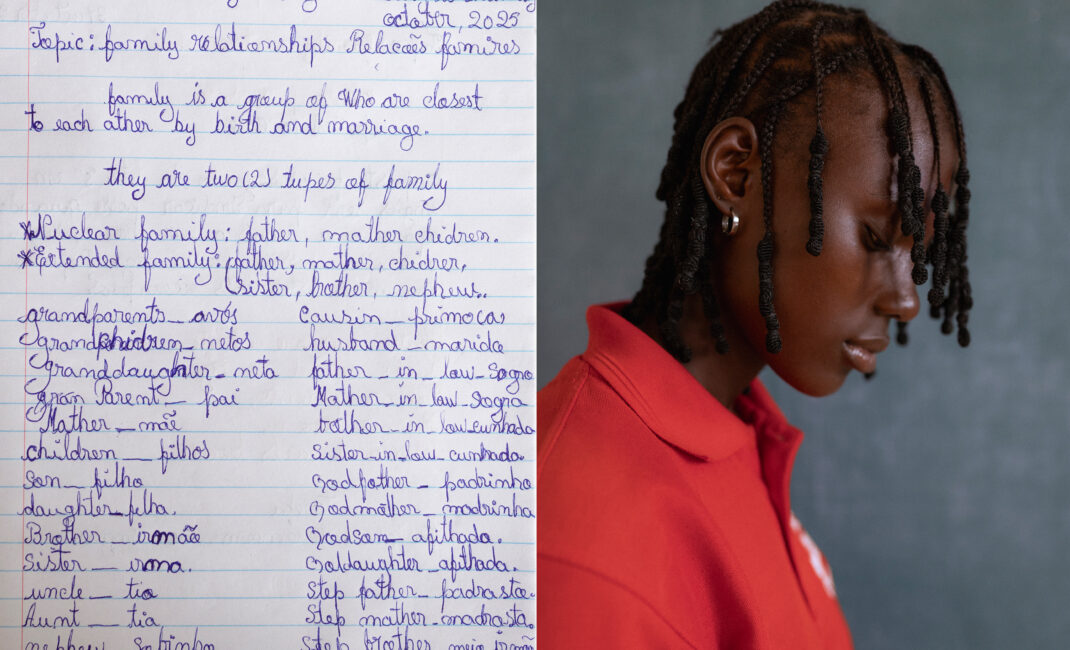
“They will realise just how urgent it is to include this in the curriculum…”
In a country still reeling from a brutal civil war that ended in 2002, access to education has been one of the lowest priorities on the political agenda. Sex education has not even been considered.
In 2020, Angola received a total of $250 million from the World Bank to invest in the Projecto de Empoderamento das Raparigas e Aprendizagem para Todos (PAT II) 2020–2025 programme, the goal of which was precisely to improve sex education for adolescents, and particularly for girls. In November 2025, with just one month to go before the programme was due to end, the government decided to extend it until 2027, as the targets set had not been met.
To deliver the lessons, they hired three NGOs: CAJ (Youth Support Centre), Mwana Po and World Vision. “When the project began, the government didn’t have any staff working specifically on this; instead, the teachers themselves tried to find time to explain things, but always within their normal teaching hours.
“It was no use, because the children still didn’t know what a condom was, nor did they understand anything about sexually transmitted infections. That’s why [the government] thought it was necessary to hire people who were fully committed to the project,” says Zenaida, an educator at Mwana Po.
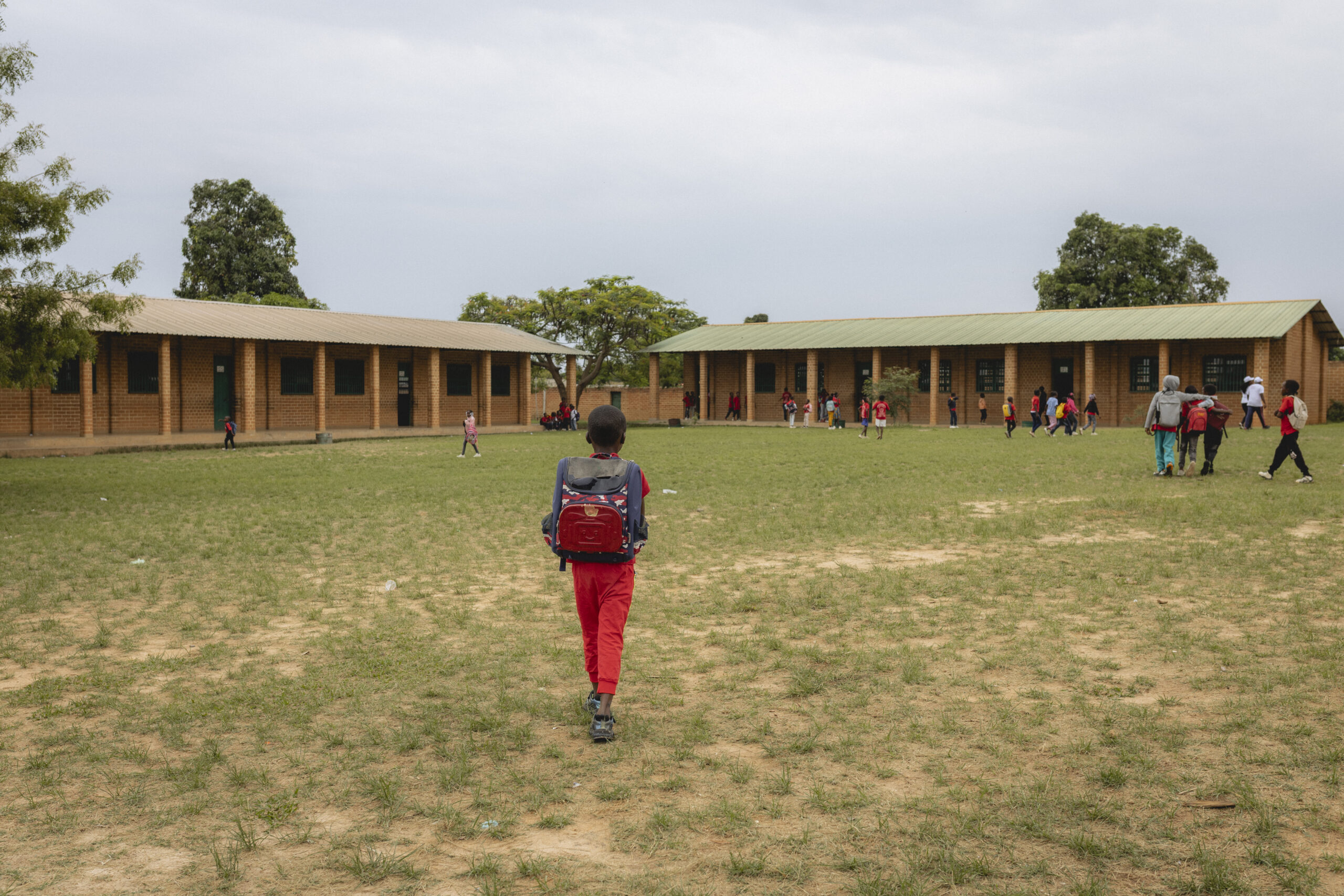
A boy walks to class at the Sagrado Corazón School in Alto Luena. Photo by Macarena Pérez Herrera
Zenaida arrived at the Sagrado Coraçao School in April 2025, five years later than planned. For most of these teenagers, aged between 15 and 18, it was their first contact with sex education. By then, there were only a few months left until the end of the school year, and with it, the end of PAT II.
“School is the best place to teach them, to give them information so they can see the risks involved in these pregnancies: miscarriages, premature births, low birth weight, or even the death of the mother or baby,” Zenaida says.
But Zenaida’s role in the classrooms is not limited to teaching; it also involves listening. “We’ve actually come across some very serious issues, including very young girls who already want to have children because that’s what their families tell them,” she laments.
To this end, both the educator and NGOs are calling for sex and reproductive health education to be established as a formal subject within the curriculum. “Our request to the Department for Education is that it should become a year-round course taught by a dedicated teacher, always. Not just occasional talks with supporting materials. But they probably won’t reply until 2027,” she says.
Until then, teachers will need to gather as much information as possible about these teenagers’ sexual health. “When we present our findings, they will realise just how urgent it is to include this in the curriculum,” he predicts. “It’s a subject that takes a long time to cover, particularly when it comes to explaining the menstrual cycle,” he adds.
In addition, part of these materials consists of books that were intended to reach every student between the ages of 15 and 18 in every school. One by one. “These pages are designed to stay with them for life, even after they finish their studies, to remind them of what they’ve learnt about the menstrual cycle and how to maintain healthy relationships. That’s how we’ll have a developed society,” argues Zenaida.
However, the books aren’t being distributed. At the Sagrado Coraçao School in Luena, there are only two books for around 100 pupils.
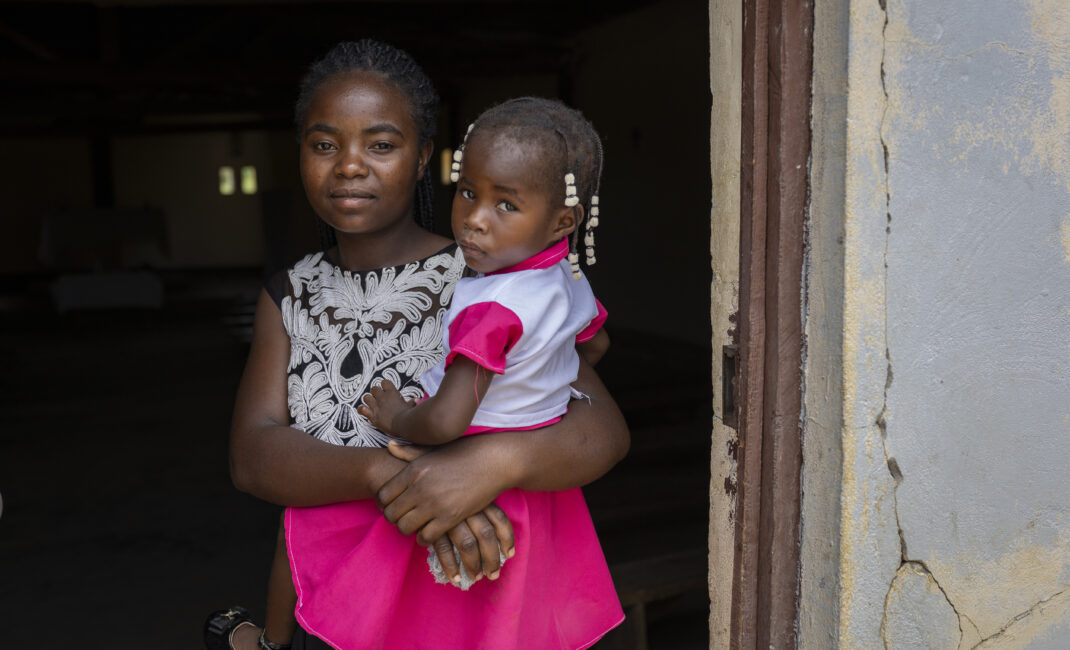
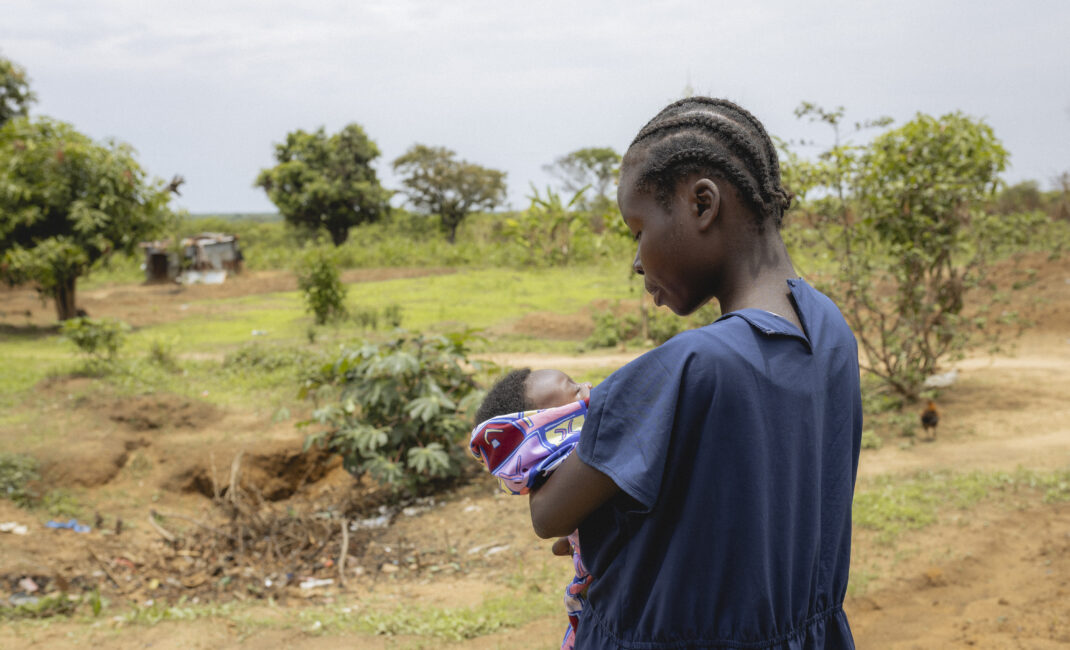
“Relying on programmes isn’t good…”
Despite the slow progress and the obvious need for more resources, Luena Maternal Hospital is beginning to offer glimmers of hope. “Many young women go there to access family planning services. Some with their parents, others on their own. It’s having an effect,” she is pleased to say.
Although the change is not drastic, she believes it will gradually take hold. “We’re going to keep trying, by going out, talking to people, taking materials to the schools where we already work, without forgetting those girls, and always accompanying them,” she argues.
These projects are helping Angola to move forward, but it is not yet standing on its own two feet. “Confusion still reigns in people’s minds. There were too many years of war and still very few of peace,” says Bartolomeu, a health worker in his forties. Although he specialised in war injuries, particularly those caused by landmines, his life now revolves around maternal and child health.
After more than 20 years in the profession, he emphasises all the work that remains to be done in Angola:
“A large number of children are in school today, but we’re not about to start applauding yet.
“Relying on programmes isn’t good. Because they start and they end. Sometimes successfully, sometimes not. But there are things, such as schooling or sex education, that should remain forever”.
All photographs by Macarena Pérez Herrera