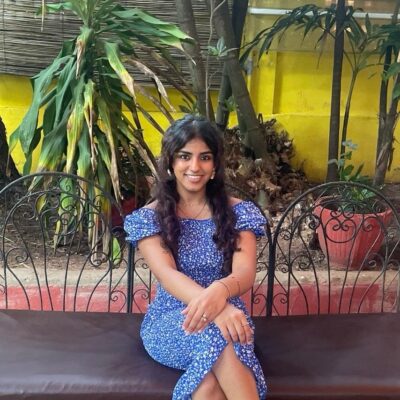
Growing up in a British Indian family, expectations were clear: success meant becoming a doctor or engineer, not chasing a place on stage. In this piece, our student writer Rachana Duraivelan explores how colonialism has shaped generations of attitudes towards pursuing the arts, and finds her own way forward.
I was always a dreamer. Since I can remember, every time I watched The Voice or Britain’s Got Talent, or saw any kids my age on TV, I’d be on the sofa yearning to be them, kicking my legs in glee.
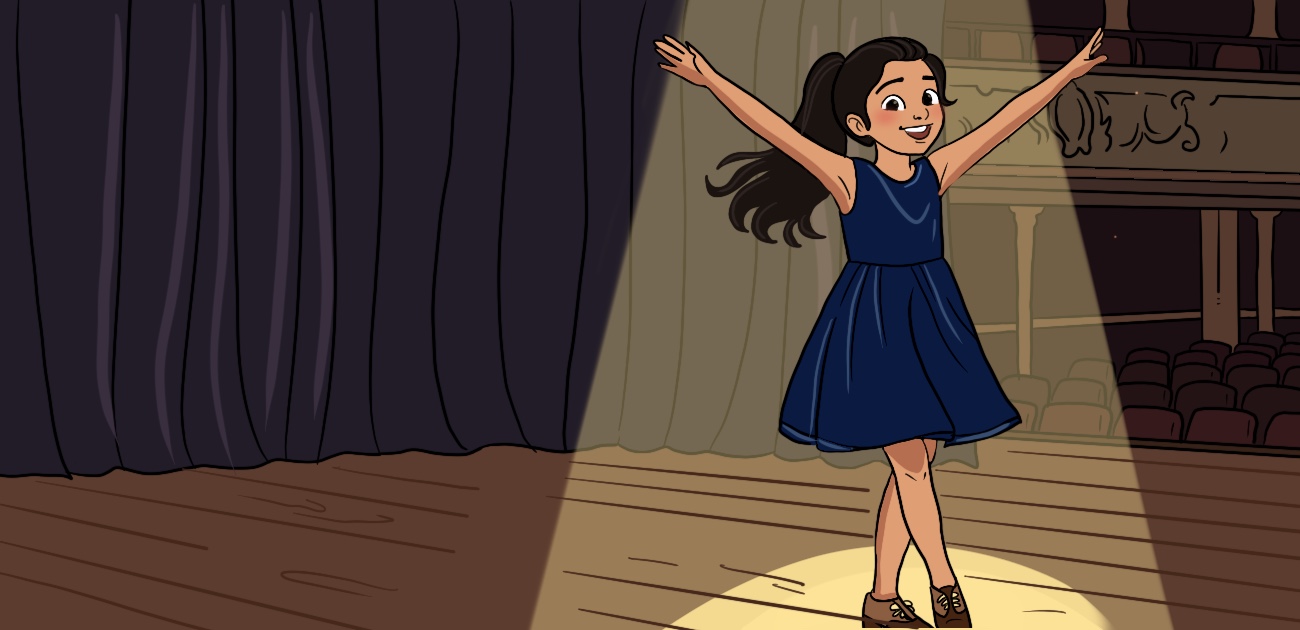
My love for performing started small: when I was four, my grandma taught me Indian songs called “slogas”, and I’d perform them at functions, soaking up the applause that followed. Singing and performing made me feel alive, a joy I couldn’t find elsewhere.
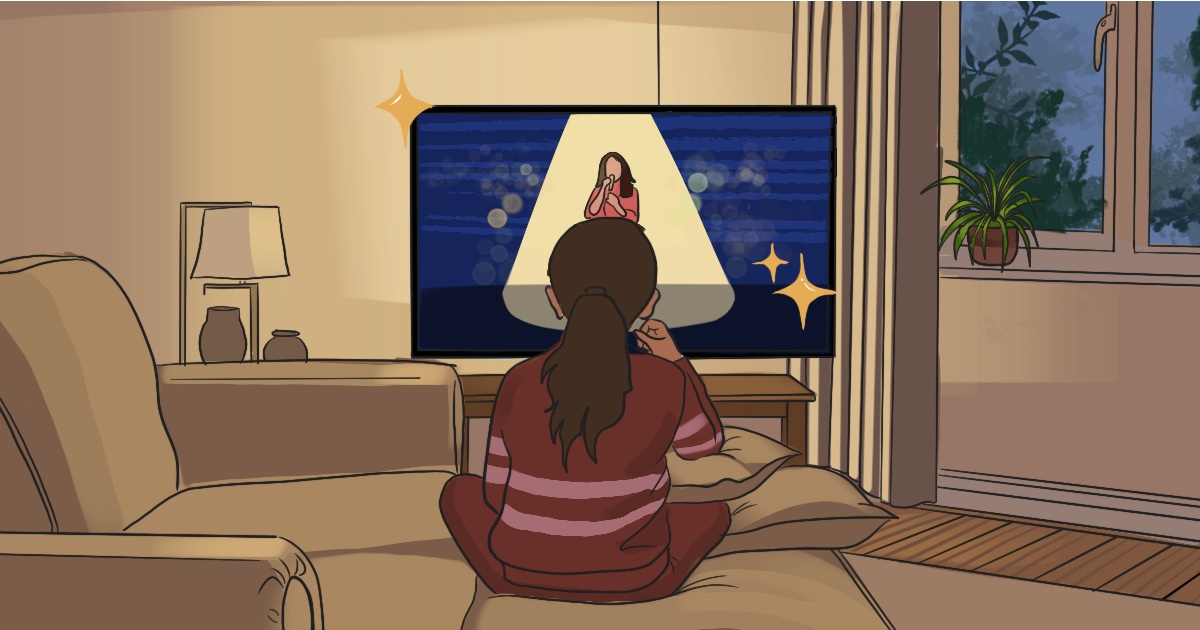
The comments were always “she sings very well” but they were quickly chased by: “What school are you putting her in?” or “How are her studies?” I began to wonder…why did it stop there? Why did a simple “well done” have to be the end of my singing pursuits?
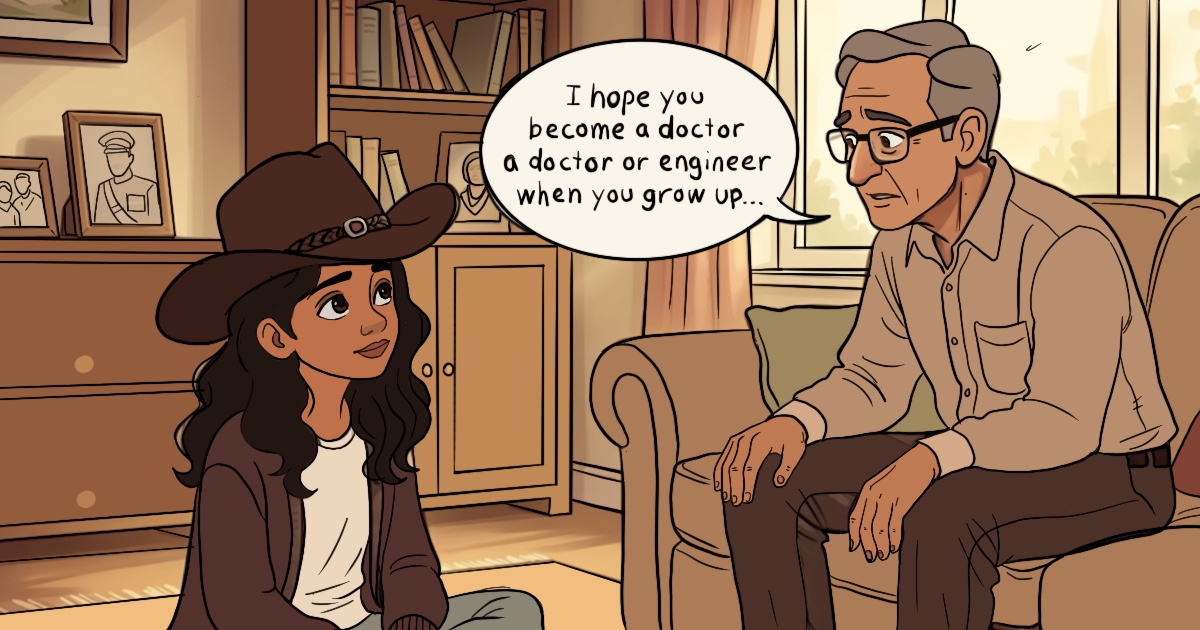
Still, I persisted. In year 2, I played a cowgirl in the Christmas nativity and stole the show, winning the coveted Star of the Week award. (Disappointingly, an acting deal didn’t follow). Naturally, my mum and dad were proud, but the topic shift was immediate.
“Have you finished your maths homework? We need to put you in maths and English tuition, so you’re top of the class.”
“Why?” I’d ask.
“So, you can become a doctor or engineer one day,” mum beamed, face cradled in hope.
To me, my parents’ career aspirations seemed to appear out of thin air. None of my teachers ever echoed them. Mrs Gleave told me I was destined for big things, that I was a performer. My white, middle-class friends all said: “Pursue what you love!”
But our family friends’, like Krittika auntie? “I hope you become a doctor or engineer when you grow up, Rachana!”
There it was again. The golden two.
At first, I wondered if I was overthinking it. But stepping back, the pattern became impossible to ignore. What felt like a quiet nudging away from stages and microphones was stitched into the wider fabric of British Indian life. I checked the facts for a glimmer of reassurance. Instead, they sharpened the truth.
Jatinder Kaur Kang’s study on British-Indian career success quoted her own experiences: “Myself and my siblings are all considered unsuccessful by the previous generation, because none of us chose to become doctors, dentists, pharmacists … thereby offering them nothing to celebrate.”
It struck an all-too-familiar chord. In the same research, tutoring providers had reported how Indian parents found it “humorous” when they suggested teaching art.
Read more: Agnes Wanjiru: What does her family’s fight for justice reveal about the legacy of colonialism?
Kang Kaur’s statistics confirmed it, too. In my teen years, British Indians made up barely 2% of the population, yet around 12% of all doctors. But on screen? Ofcom monitoring shows South Asians are significantly under-represented in major television roles. Indians are present in such negligible numbers that they vanish into the data. Even the British Council says audiences want British-Indian stories, yet the industry rarely nurtures the talent to tell them.
I know what the sceptic will say: the arts are precarious for everyone, singing and acting come with no guarantees. Surely the cautionary signs around me apply the same for everyone? Indeed, uncertainty is baked in. But what they miss is that risk doesn’t weigh the same when safety nets are unevenly distributed.
Not just for British Asians, but for ethnic minorities across the UK, the rules are stacked differently. Arts Council England findings, reported by The Guardian, show that ethnic minority creatives remain under-represented in senior and decision-making roles. Acting and singing may be unpredictable for everyone, but that uncertainty carries heavier consequences for those without informal networks, second chances, or institutional protection.
Ethnic minorities remain without a social safety net in the arts whilst white and middle-class individuals are framed as more “passionate” or “resilient”. The extra structural and racial burdens minorities face, atop the inherent unpredictability of the arts, is blurred.
The fear of unpredictability is unevenly distributed, and not everyone has the same opportunity to recover from it.
So no, it was never only in my head. That hesitation around music and acting present in families like mine wasn’t random. It was shared and painfully real. I could not unsee it.
The more I encountered it – the aunties prying about GCSE subjects, the extended family phone calls – the more bitter resentment settled in my belly.
One call with my grandad on my mother’s side stands out sharply.
“So, Rachana… what do you want to do?” His static-filled voice over the phone glimmered with anticipation. I was 15 then, but my hunger for singing and acting still beat fiercely in my chest with every “do what you love” repeated like a mantra by my white secondary-school teachers.
“I want to act and sing, thatha” [grandad] I said, hesitant but hopeful.
I could feel his furrowed brow and amused smile stretch across the miles between us.
“Oh, kutti” [a way of addressing little kids in Tamil] he chuckled. “That’s a hobby. That’s not respectable. What is your actual future?”
The throwaway comment chipped at my heart. Respectable. That word had never once been uttered by my English teachers. “Respectable career” slipped only from the lips of my Indian aunties, parents, and family.
What was so disrespectful about singing or acting?
The tipping point was my dad’s lecture during my GCSE options. His words remain cutting in my mind. I had just finished a TED-talk-style proposal to take music and drama instead of computer science, much to his disappointment and, frankly, anger. His voice boomed through the kitchen, drowning out the extractor fan that whirred nervously in the background.
“Rachana… dreams are just that… dreams. Let it go.”
The words hung heavy. Tears dotted my shirt. That day, I decided my dad was the villain. My culture, my Indian heritage, felt like a curse. A weight that tethered me down.
The way I saw it, we clung to the “respectable” doctor-engineer path because our minds were too closed.
“Britain understands better,” I thought. My English teachers, my classmates, the culture that told me to leap – they were better.
As the years passed, maturity softened my anger. When I finally took music and drama, my parents’ eyes didn’t blaze with judgment; they trembled with fear.
I can’t pinpoint the exact moment, but sometime after I turned 15, their voices changed. My parents, once outright dream-crushers, became weary worriers. Shaking their heads as if bracing for impact.
“Oh, I hope it wasn’t a mistake, Rachana.”
“Pursuing these pastimes shouldn’t distract you from something stable.”
They spoke as though stability was one careless choice away from shattering. During Year 11, I finally asked my dad what had been simmering inside me for years.
“Dad, you love Tamil songs, right? And Tamil actors? So, what’s so wrong with me trying?”
His expression softened. “Kanna [my dear] … every penny your mum and I have made has come from clawing our way into acceptance here. Risk is a luxury.”
In my head, I rebelled. But then it hit me: we are comfortable, yet the margin for error is razor thin. My English peers in choir, sent off to art schools, introduced to talent agents, and supported by enthusiastic parents? Their dreams were treated like investments, not gambles.
What looked like bravery in others would be recklessness for us. Taking risks demanded an extra mile, an extra generation, an extra sacrifice; and my parents’ warnings were less about control and more about love and survival.
That’s when the wondering crept in: Where did Indians’ fear of pursuing the arts really come from? Were we always this way?
The fear didn’t begin in my living room. It didn’t start with my parents. It started much earlier. In classrooms that were never meant to make anyone dream.
Under British colonial rule, education in India was quietly reshaped to reward obedience over imagination. British colonialist Thomas Babington Macaulay’s Minute on Education in 1835 laid this bare.
The goal was to create Indians who could think, work, and behave like the British. People who are useful enough to manage paperwork, keep accounts, and hold the empire together. Schools trained students to memorise, comply, and speak the right language. Creativity and the arts weren’t just ignored; they were treated as distractions.
A 2023 research paper from Adikavi Nannaya University shows that colonial education was deliberately structured around English-medium training for professions that served the imperial state, especially medicine, and later engineering.
I kept returning to a line from Vinay Menon’s TED Talk: Students were trained to “sit at a desk, do what they’re told, and not be too creative,” he says.
That mindset didn’t stay in textbooks. It hardened into reality. While England built 23 government-funded art schools, India, with a population of nearly 200 million, had only 4. They were scattered far apart, poorly funded, and disconnected from any real industry.
These schools weren’t designed to raise artists. They trained craft workers to improve goods for British markets. Art became labour. Expression became utility. For most people, choosing the arts wasn’t a gamble. It simply wasn’t an option.
Slowly, something deeper shifted. Indian music, theatre, and performance were pushed out of public life and dismissed as unprofessional or inferior. Colonial records described them as “not quite music,” while European art was elevated as refined and serious. When creativity is removed from public platforms, it begins to feel small. A “hobby”, but never for a living.
Over generations, this turned inward. Indian political psychologist Ashis Nandy writes that colonialism did more than occupy land: it settled inside the mind. Ideas of respectability changed. Emotional expression and performance began to feel dangerous.
Education stopped being about wisdom or self-discovery and became about employability and control. Creativity didn’t disappear. It just lost its dignity.
Then came migration. First-generation Indian migrants often entered societies where survival took precedence over self-expression, and work meant security, not fulfilment. Studies show this demographic values stability and income more than their host-country peers, not because they lack imagination, but because unpredictability once came with real consequences. That fear has been unwillingly passed down.
For the first time, I saw my parents differently. The aunties. My grandparents. They weren’t trying to shrink my dreams. They were protecting me with the only language history had taught them.
What we believe is “respectable” was shaped long before we had words for it. The fear wasn’t in our blood. It was inherited…with trembling hands.
But inheritance is not the same as inevitability. To understand my parents’ fears as simply the product of colonial history would flatten the complexity of their lives and strip them of the agency they exercised within it.
Colonialism may have laid the foundations for what came to be seen as “respectable”, but those ideas were continually reshaped by migration, racism, and lived experience.
My dad, for example, grew up with far fewer opportunities than I did. Coming from a poorer background, reliability was never an abstract virtue; it was survival. The luxury of gambling on an uncertain future simply wasn’t available to him.
Research suggests that ethnic minorities like South Asians often find themselves feeling “out of place” within elite British institutions.
Creative industries, perhaps more than almost any other profession, rely on subjective judgement, informal networks and gatekeepers whilst traditional careers such as medicine, engineering and law offer qualifications that travel more easily across social boundaries. Success rests more visibly on demonstrable competence than on belonging to the right circles.
For parents who had experienced exclusion firsthand, those careers represented more than prestige. They offered the promise that hard work might finally be judged on its own terms.
Colonial history was only the beginning. Over time, inherited caution hardened into “common sense”.
Once I understood where my culture’s fear came from, I was left with a new, quieter question: What do I do now?
Should I let these inherited ghosts anchor me down? Allow generations of caution to limit how far I could go?
Or should I leap blindly? Chase auditions, sing and act with reckless abandon, pretending this history had no hold on me at all? Ignore the weight of “respectability” that had shaped my parents and grandparents, and brand it all as backward thinking?
Neither felt right.
Healing, I realised, wasn’t about rejection or erasure. It was about understanding, then choosing differently.
Instead of running from this history, I leaned into learning. I became curious about the very structures that had shaped our fears so precisely. That curiosity led me to study Law and Sociology at the University of Warwick. On paper, it looked sensible. “Respectable”, even. But it didn’t feel like surrender. It felt like a quiet rebellion.
Sociology sat uncomfortably with my family’s deep-rooted attachment to STEM, an attachment I now understood was never about prestige, but protection.
And yet, even as I studied power, systems, and inequality, the desire to perform kept burning. At 18, the pull toward singing and acting remained undeniable.
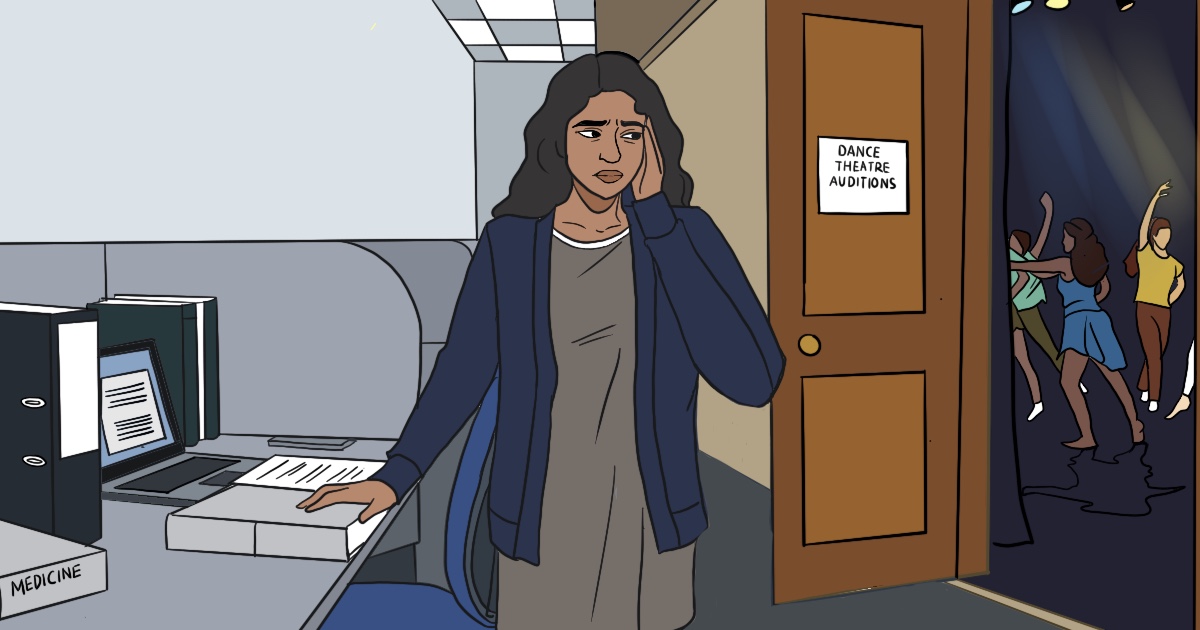
A few months before university, I remember rushing downstairs, heart pounding, and speaking directly to my dad. Not with teenage fury this time, but with clarity. Resolve.
“Appa” [father] I said. “I’m 18 now. I’m an adult. My desire to sing and act hasn’t faded. This isn’t a childish fantasy anymore. I won’t go through life without trying it.”
I came prepared with my plan: I would start posting singing covers on TikTok.
And I did.
I would take a professional acting course, pursuing this seriously alongside my studies.
And I did.
Persistence, paired with understanding, softened something. Slowly. My parents paid for my acting courses and agreed to put me on a casting website. These weren’t grand declarations of belief, but they were gestures of trust. That mattered.
At university, the world opened further. I joined a professional a cappella group that competes nationally, and is now working toward releasing recorded music on Spotify.
For the first time, performing didn’t feel like sneaking around in fear. It felt real.
Of course, the echoes didn’t vanish. Fear doesn’t dissolve just because you name it.
One day, on the way to a screen acting class, my mum broke the silence in the car.
“Rachana… I read somewhere that directors ask actresses to sleep with them,” she said quietly. “There are so many risks. Why get into all this?”
Fifteen-year-old me would have snapped. I would have accused her of being narrow-minded and controlling. But this was a 20-year-old me. Someone who finally understood that fear and love often sound the same.
I smiled gently. “Amma, life is full of risks. But taking them is what gives life meaning. I can’t live inside our culture’s fear of instability forever. I need to do this.”
She looked at me differently then. Not convinced. But listening.
“Well,” she said slowly, “if you become a big singer or actress… I’ll be the first to be proud of you.”
It wasn’t a full transformation. The fear of the arts didn’t disappear overnight. But those words were a step outside the box. Proof that art, creativity and performance didn’t have to belong only to others.
So why retreat into colonial shadows?
Why accept stolen stages as fate?
I choose instead to reclaim my right to perform. Grounded in my history but no longer governed by it. And I hope others can find their own stage, too.
All artwork by Lacuna artist Wong Yan Yee