
The Labour government’s “earned settlement” scheme is part of a raft of hardline immigration reforms. But critics say lengthening the time it takes for visa holders to earn settlement from five years to 15 will hit the UK’s care workers hard and go against Andy Burnham’s vision for a National Care Service. This feature recounts stories of isolation, sacrifice and self-deportation from Britain’s social care workers – and explores alternative solutions.
Hunched over my phone, with fingers poised on my keyboard ready to transcribe, I wait for the response to my question: “What is your experience of these policies?” A breathless whisper comes back, “Wait, I am worried they will hear me. I am trying to leave so it is safe to talk.”
I work as an organiser for the trade union UNISON and I am trying to speak to Tammy*, a care worker from Zimbabwe, about her experience of the Skilled Worker visa. Tammy is audibly distressed, but she does not hang up the phone:
I need to tell you about this”, she says. I hear muffled sounds of her hasty departure as she buzzes through the security doors and scribbles in the sign–out sheet.
Finally, the phone is uncovered. There is a steady hum of traffic, but Tammy’s voice is clear now and she begins to tell me her story: “So, I came to the UK in 2022 to study Business Analytics… Instead, I became trapped in what the government calls an ‘unskilled job’.”
This call is one of hundreds I made in the months building towards a National Day of Action on 17 December 2025 when over 700 migrant care workers travelled to Parliament to deliver testimony to their MPs. The day, against all odds, was a landmark in UNISON’s Fair Visa Campaign as one of the biggest parliamentary lobbies in modern history.
Thousands of UNISON members travelled from every corner of the UK to make a case for change directly to decision makers. The marble walls of Methodist Hall in Westminster echoed with the voices of people like Tammy who, after years of forced silence, came together in joyful defiance to sing their own self-scripted version of the trade union anthem, ‘Solidarity Forever!’
Tammy, like many migrant care workers, came to the UK on a student visa with dreams and ambitions. But she found it impossible to complete the placement year of her Master’s degree in business analytics because every large employer she interviewed with, such as banking and financial firms, turned her down – sometimes at the last stage – due to them not having a licence to sponsor migrant workers on lower tier visas. So, Tammy found herself working in care.
She describes how, despite this, she embraced the career, working to become a senior team leader in a residential care home with ambitions to complete her NVQs, move into care management and one day become a director.
However, like many other social care workers who describe being forced to take night shifts or gruelling domiciliary care work, Tammy is trapped in a situation of “coercive control” as employers pressurise workers by using their visa against them. She explains how the visa has been used by her employer to rule through fear. She has heard managers say, “Have you forgotten you are on sponsorship?” to silence workers who speak up.
She tells me this in whispers while trying to leave work, saying, “I walk on eggshells. If I raise concerns, seek union support, or challenge unfair treatment, I risk becoming a target. Every decision I make is filtered through fear of losing my sponsorship.”
Tracey, another care worker from Zimbabwe, echoes this, adding that, “one colleague who planned to testify alongside me when meeting with our MP withdrew, saying ‘I cannot come anymore because I don’t want any trouble by testifying’”.
The true extent of exploitation remains hidden she explains, “because fear keeps people silent… speaking out could jeopardise my job and therefore my family’s security and future”.
Trapped in a visa system that feels like ‘modern slavery’
Since January 2021, the UK has operated a hierarchical, points-based immigration system with “High-value migrants”, including entrepreneurs, investors and those with exceptional talent in science and arts at the top, and “Skilled Worker”, “Health and Care Worker”, “Student”, “Child Student” and “Graduate” and “Temporary Work” visas below.
Whilst “High-value migrants” enjoy the freedom to switch employer or start a business, a three-year fast-track to settlement and comprehensive family and dependent rights that includes the right to study without a student visa, all others on work visas find themselves trapped, tied to their employer and kept silent by fear of deportation.
Tracey tells me that for her life under the current visa system feels like “modern slavery”. When Tracey came to the UK from Zimbabwe for university, she hoped to study, start a career as a psychologist and build a life in the UK, but after graduating she found that the only ‘Skilled Worker visa’ jobs were the lowest paid with limited progression and vulnerable to exploitation.
During a short window of time between getting her children to sleep and preparing meals for the week before her night shift, she explains feeling “deceived in coming here”.
“I considered speaking out on this but didn’t have the courage. I am tied to them so had to stay silent,” Tracey says.
The Certificate of Sponsorship – tying immigrants to employers
What Tracey is describing here is The Certificate of Sponsorship (CoS), a digital work permit which can be issued by Home Office-approved employers to foreign workers most commonly under the Skilled Worker and Health and Care visa routes.
These workers, many of whom have taken the life-changing decision to live and work in the UK, find themselves trapped and unable to speak out against abuses for fear of losing not only their job but also their right to be in the country.
The only escape in this scenario is to find another eligible employer within a 60-day window, something that is extremely difficult to do.
The result is being trapped in a two-tier system which is becoming institutionalised in the care sector. As Samantha, a Nigerian care worker puts it, “this [CoS] visa traps people. It ensures a constant supply of carers who cannot leave, cannot progress, and cannot escape exploitative employers. It crushes hopes, dreams and futures.”
When viewing the government’s new hard-line migration policy alongside the lived experience of migrant care workers, a question emerges – if this isn’t a deportation policy, what is it?

What is “earned settlement”?
The idea of “earned settlement” was first introduced in the UK government’s Immigration White Paper in May 2025. Where people on lower tier Skilled Worker and Health and Care Visas currently face a five-year journey to securing settlement in the UK, the new proposal extends this up to 15 years, retrospectively and possibly 30 years for asylum seekers. Settlement must be earned by those on lower tier visas by fulfilling the four pillars of Character, Integration, Contribution and Residence, which will be measured through regular checks by the Home Office.
This is the flagship policy of Home Secretary Shabana Mahmood. After mentioning small boats five times in her speech to the Labour Party Conference in 2025, Mahmood referred to her parents who “came here in pursuit of a better life. Who worked hard, contributed to this country and, in time, became a part of it”.
Migrant care workers find themselves in perpetual uncertainty, somewhere between “boat people” (bad migrant) and the post-colonial immigrant workers of the past (good migrant).
Migrant care workers, nevertheless, make up nearly a quarter of the estimated 1.6 million people due to be eligible for settlement by 2030.
During February’s Westminster debate, former Parliamentary Under-Secretary of State at the Home Office, Mike Tapp, declared that these figures (citing the inflated number of 2.2 million) pose an imminent threat to public services and community cohesion.
In fact, the Migration Advisory Committee’s (MAC) recent study shows that the 2022/23 cohort of Skilled Worker and Health and Care Worker visa holders have an average net lifetime fiscal impact of +£44.4bn on the UK economy (and this factors in the negative fiscal impact of adult dependants and partners).
Tapp expressed that “settlement here is a privilege, not a right,” emphasising that this change is not a deportation policy, but about “creating a system that is based on contribution and integration.”
The concept of “earned settlement” continues to lean into this narrative and appears to be part of the Labour government’s policy strategy to appeal to would-be Reform voters by lumping together all non-permanent residents for performative punishment purposes.
The experience of migrant care workers, is not one of waiting but rather one of being trapped. Amid the many concerns about the new policies, is the fear that “earned settlement” will create ‘Windrush 2.0’ or perhaps an even more extreme ‘Windrush+’ system in which financial exploitation and deportation of those vital to our public services is formalised and inescapable.
Domiciliary wear and tear
Samantha and Musa are Nigerian care workers with more than two years’ experience working in domiciliary care in a rural English county. Samantha, like many others, started out in the sector due to its proportionately high vacancy rates.
She spent two years working six days a week, 7am to 10pm, for £400-a-week. Samantha describes leaving this role as a visiting carer to instead work in a residential care home because she was not paid for the time spent travelling between clients.
Samantha reflected on how she was thrown into a “sink or swim” situation, being “sent to drive long distances, including rural roads in winter darkness and black ice conditions I had never experienced before [with no] additional support for being new to the country”.
It was not long before she crashed into a ditch, after which she “developed panic attacks [where] every morning I felt sick, as if the car was closing in on me”.
She describes the long-term impact on her health and family life as “devastating”. Working extreme hours left her “chronically exhausted and isolated” to the point where she was diagnosed with a severe vitamin D deficiency, sciatic nerve damage and knee issues due to the constant driving.
Her daughter had to cook her own dinner most nights after school because Samantha was never home.
On receiving clear advice from her doctor to cut down the driving or do permanent damage to herself, she realised that she had a stark choice to make: “work myself to death or leave”.
Samantha managed to escape to a care home sponsor, but she is unable to recover as she continues to work in a similar environment for long hours, six days a week. Despite trying to complete her NVQ with plans to progress into specialised care, her outlook is bleak: “I fear that after five years my body will be broken. Fifteen years feels like a death sentence.”
Musa reported working up to six days a week, making on average 20 house calls per day from 7am to 10.30pm. He describes how the physical strain from the relentless hoisting of clients has left him with chronic back and shoulder pain. He now relies on pain medication and needs recovery days after working five consecutive long shifts.
He pushes on, taking consolation in the clients he cares for. One felt so strongly he wrote to the Home Secretary, telling Musa, “I wish they knew the impact carers make in my life.”

Musa loves his work and has tried to negotiate with his private domiciliary care company employer for sustainable adjustments, but explains that, “I cannot easily reduce my hours or challenge conditions because my immigration status depends on sponsorship. I feel stuck. I cannot freely move jobs, retrain, or plan my future… Fifteen more years feels like giving my life away.”
Musa describes a system that is broken. It is a situation in which employers are taking advantage to exploit CoS to different degrees, in the best scenario due to real pressure to meet increasing service needs, in the worst due to outright exploitation for profit.
Imprisoned in a residential night world
Life on the road as a domiciliary care worker has become notorious as the most demanding and least financially rewarding area of care work. Like Samantha, many escape into residential settings to avoid the danger and exploitation of relentless unpaid driving.
Aleena, Tracey and Tammy arrived in the UK on student visas. They all hold Master’s degrees but find themselves forced into a sponsorship arrangement at a care home where night shifts are compulsory.
Aleena is in her twenties and, after completing a Master’s in marketing, found herself working as a carer to secure sponsorship. She worked 10-hour night shifts four times a week consistently for a year because:
the visa stops my flexibility… I must constantly work unsociable hours under what feels like duress… The employer is the governor of our lives, and we are prisoners who must comply.”
Sponsored workers become self-described “guardians of the rota” who scaffold native staff on flexible zero-hour contracts, creating a two-tier workforce where sponsored workers’ leave is restricted and shifts are compulsory. In this situation, Aleena says she cannot freely travel home to see family because “my absence would clash with rota shortages”. Her daily life is ruled by fear that her employer, “holds the key to my future”.
The relentless, inflexible work makes her fear that her “back will be damaged long term” and her “sight affected” because she must strain her eyes when working in the dark. “I feel my eyes dimming”, she reports.
When considering the “earned settlement” implementation, Aleena becomes distressed, explaining her concern that, “after 15 years I will be blind. I have read you can damage your brain from working relentlessly at night”. Her mental health also suffers. As a young person far away from home she is unable to socialise or visit her family:
“Working like this isolates you... When I return home, I sleep through the day. When I am awake, everyone else is asleep. I live in my own night world.”
A potential way forward in a Certificate of Common Sponsorship
Migrant care workers’ stories tell of more than unfairness. The injustice and inhumanity of their lived experience is palpable. As “earned settlement” looms, each person I spoke to describes their lives as a form of incarceration. As Tracey put it, life under the visa feels like “modern slavery. Not in chains, but in dependency”.
Migrant care workers theoretically have access to education, healthcare and rent, can buy a house, work and travel in and out of the country. In reality, however, these essential requirements and basic rights for a sustainable life, remain a long-faded dream for most and just out of reach for a frustrated few. All continue to suffer and attempt to smile through.
In contrast, the Certificate of Common Sponsorship (CCS), which was first tabled on 3 December 2024 by Labour MP Neil Duncan-Jordan, calls for a sector-wide sponsorship scheme. This would target the cause of the inequality and hardship by empowering migrant workers with the freedom to move between employers.
Supporters of the proposed new CCS believe it could address the exploitation at the heart of the current system. By affording migrant workers the freedom to safely choose their employer and report those who are unscrupulous, it will finally close the loophole that has allowed these conditions and exploitation to flourish.
Samantha believes this would allow care workers to take back control of their lives. She explains: “I would be able to balance my shifts, see my daughter, function better, be healthier, work sustainably and progress to improve the sector, for carers and those we care for.”
While acknowledging UNISON’s key campaign asks for a CCS, Tapp aligns it with limiting the government’s ability to “punish those dodgy employers who are dishing out visas when they clearly should not be”. This misses the point that, by affording care workers more autonomy, rogue care providers who are exploiting the CoS system can be more easily reported, exposed and deterred.
This is a sector that is chronically underfunded and widely misunderstood. The CoS system represents the bluntest and most exploitative tool which, perpetuated by the ideology of “earned settlement”, enables what Tracey describes as a “subtle violence” to prevail in care settings across the land.
There is a blight at the root of the current system that enables any employer to exploit and abuse migrant workers, whether to meet service needs, maintain their bottom line or to extract profits.
In the face of this, UNISON members continue to campaign for CCS, holding another day of action in Westminster in June when care workers lobbied their MPs. Movingly, a vigil was held for colleagues who have lost their lives under the current single-employer sponsorship model due to being trapped in dangerous working environments, and as reports of racist attacks on health and care workers increase.
More recently, around 400 demonstrators, many symbolically wearing balls and chains, gathered outside Labour’s conference in Liverpool, where UNISON general secretary Andrea Egan said the promise of settling after five years was being replaced by “the threat of 15 years of insecurity and exploitation”.
Migrant workers have been essential in holding our care services together and will be vital to filling the estimated 440,000 roles needed in social care in England by 2035. They deserve be fully involved and heard in the national conversations to come, rather than targeted and maligned. They demand the dignity, respect, humanity and access to collective bargaining that are currently denied to them and the sector as a whole, which is why it is essential that CCS is implemented at the heart of a National Care Service and why it remains central to UNISON’s Fair Visa Campaign.
*All names and backgrounds of the workers interviewed for this article have been changed or withheld to protect their identities.
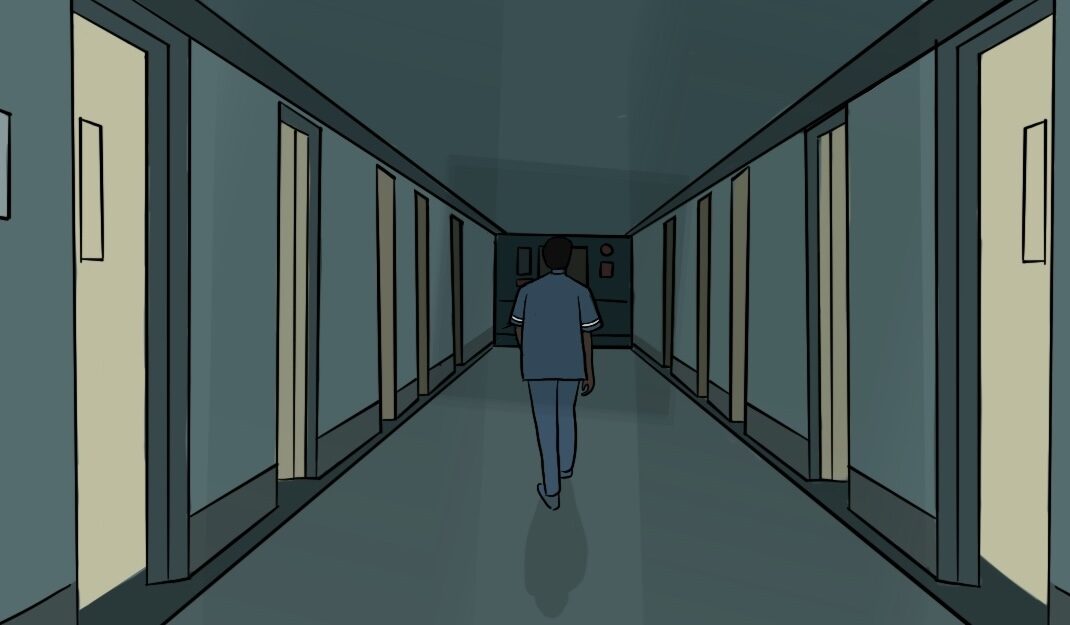
All illustrations by Wong Yan Yee
Read more: