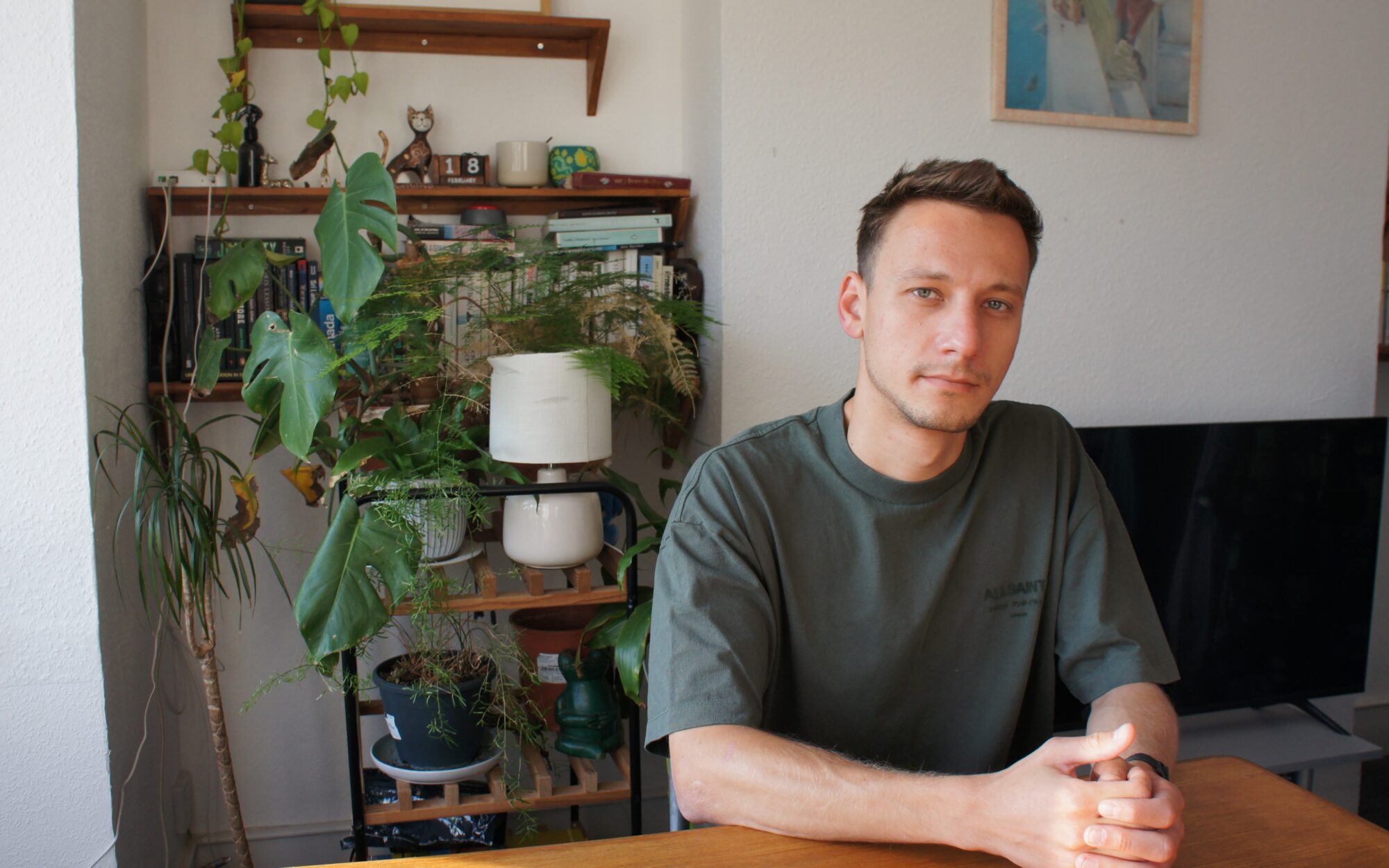
For 14 years Mark Fomenko has been following immigration rules to gain settlement in the UK, but the rules keep changing. Recent changes have wiped away the records of Ukrainians who made a home in the UK long before the conflict with Russia began. And Labour’s “earned settlement” proposals are about to make things even harder.
“Straight away my heart dropped because I realised that… I realised it was really bad.”
Speaking in his living room in north London, Mark Fomenko recalls the moment he read a Home Office statement which transformed his life.
Photograph of Mark Fomenko by Rory MacNeish
“I couldn’t believe it in a way and was like, ‘Maybe I’m just misinterpreting it, maybe there’s more nuance to it.’”
Mark sent an email to his lawyer with a link to the statement, asking, “Does this mean what I think it means?”
The lawyer’s reply confirmed Mark’s fears – that the years and thousands of pounds he had spent to gain permanent settlement in the UK had been wiped away by a “minor change” the government had made to the Ukraine Scheme visas.
Since moving to the UK 14 years ago, Mark has discovered that the country’s complex immigration rules are in frequent flux.
Unlike other areas of legislation which require acts of parliament that are debated and voted on to enter law, the Home Secretary holds executive powers to amend rules and guidance through statements of changes, which MPs have little ability to challenge. Sweeping alterations to rules affecting the lives of hundreds of thousands of immigrants living in the UK can be implemented with short notice periods and no consultation.
For people like Mark – who has been attempting to achieve settlement for more than a decade – navigating the rules can feel more like playing a high-stakes game of snakes and ladders than following an official process with established protocol.
“If I arrived tomorrow,” he says, “I would be in the exact position I am in right now. Spending half of my life in the UK now doesn’t count for anything.”
Mark first moved to the UK from Kyiv in 2012, aged 14. Not enjoying school in Ukraine, he was keen to have a fresh start somewhere new and increase his education and work opportunities. His parents were encouraging, thinking British schooling could open the world to Mark as it had done for his older sister who studied in Brighton before starting a promising career in fashion.
Mark lived with a host family whilst attending high school in Bournemouth where he excelled in maths and physics. He went on to study Computer Systems Engineering at the University of Bath before settling in London in 2020 to begin his career as a Software Engineer.
Most of his friends and his work and life bonds are in the UK, as is, he hopes, his future. “I think my mentality is closer to a British person at this point,” he says. “This is definitely the most home-like place.”
Since his arrival, Mark has followed the UK’s “long residence” route towards gaining indefinite leave to remain (ILR). ILR, also known as settlement and permanent residence, allows an individual to live, work and study in the UK with no time restrictions and removes any employer sponsorship requirements.
Photograph of Mark Fomenko by Rory MacNeish
To qualify for ILR on this pathway, applicants must have lived continuously in the UK for 10 years on specific visas. Without the security it provides, many immigrants find it difficult to build normal lives or make long-term plans.
“You don’t really have peace of mind because at some point you could potentially just have to leave the country,” says Mark. For him, ILR represents “having freedom to do the job you want to, rather than just doing whatever you need to do to stay in the country.”
In 2024 Mark began preparing his application for ILR. He had lived in the UK for 12 years and met all the eligibility requirements. Wishing to leave no room for error, he hired immigration lawyers to advise him. They spotted a problem – a short-term student visa he was granted in 2016.
In 2014, the Home Office had issued Mark a general Tier 4 student visa but due to an administrative error, it did not cover his full term at school. This meant two years later he had to apply for the short-term student visa so he could sit his final A-levels.
At the time, this counted towards the qualifying period for ILR. However, in 2023 short-term student visas were excluded by Rishi Sunak’s government, with retroactive effect. This wiped away all the qualifying years Mark had accumulated since arriving in the UK up to being granted the short-term student visa.
The clock for his qualifying period restarted from October 2016, the date he was granted another general student visa to attend university, making 2026 the earliest date he could apply for ILR.
“I really was frustrated,” he says, but “had to just deal with the fact, because there was nothing I could do about it.”
Several months after learning this, Mark received the bigger shock about the change to the Ukraine Schemes, which turned everything upside down. Since March 2023 he had been living in the UK under a Ukraine Extension Scheme (UES). This visa was launched following Russia’s invasion of Ukraine to allow Ukrainians already living in the UK the right to stay in the country. Crucially, Mark’s lawyers had assured him, the UES would count towards his qualifying period.
Photograph of Mark Fomenko by Rory MacNeish
However, the Home Office statement which Mark found in November 2024 announced that the Ukraine Schemes cannot be used to qualify for settlement under the “long residence” route. The government has “always been clear that the Ukraine schemes provide temporary sanctuary in the UK only while the war in Ukraine remains ongoing,” it states, and the change “brings the Rules in step with the already established policy position.”
This sudden rule change swept aside the eight years of continuous residence Mark had accumulated since 2016. The Home Office has rendered Mark’s entire life in the UK irrelevant for any future application for ILR. His only option now is to obtain a new visa which counts as “lawful residence” and start building years again from scratch.
Encouraged by his friends, Mark wrote to his MP, David Lammy, detailing the issue and requesting a meeting. Lammy forwarded his letter to the then Minister for Migration and Citizenship, Mike Tapp.
Tapp’s response reiterated the government line that its offer to Ukrainians “reflects a generous and meaningful commitment to support those displaced by the conflict, while also respecting the Ukrainian government’s strong desire for its citizens to return and contribute to the country’s future recovery.”
“Regarding Mr Fomenko’s specific circumstances,” the letter ends, “the Home Office cannot provide immigration advice on specific cases.”
This response disregards Ukrainians who have made a home in the UK long before the conflict began. “They said that they always try to make sure the rules are fair,” Mark says.“When you are retrospectively changing rules, it’s moving the goalposts. That clearly isn’t fair.”
Several migration lawyers share Mark’s view. Alex Piletska, a Senior Associate at the immigration law firm Vanessa Ganguin, acknowledges that the government was clear that the Ukraine Schemes were always intended to be temporary. However, she says Student, Graduate and High Potential Individual visas are also temporary but can be counted towards the 10-year qualifying period under “long residence” rules.
Piletska described the government’s decision to remove the Ukraine Schemes from counting as “an extreme option.”
Those who applied for the scheme before the rule change, which had no public consultation or transition period, “had no idea that doing so would irreversibly destroy whatever qualifying period they had already built up.”
Mark is one of many affected by this change. Dr Ben Brindle, a senior researcher at The University of Oxford’s Migration Observatory, used figures from the Home Office’s Migrant journey dataset to create a chart showing that around 950 Ukrainians arrived in the UK in 2021 or earlier on visas which count towards Indefinite Leave to Remain and have since switched to Ukraine Schemes. Of this number, 176 have been in the UK for more than ten years.
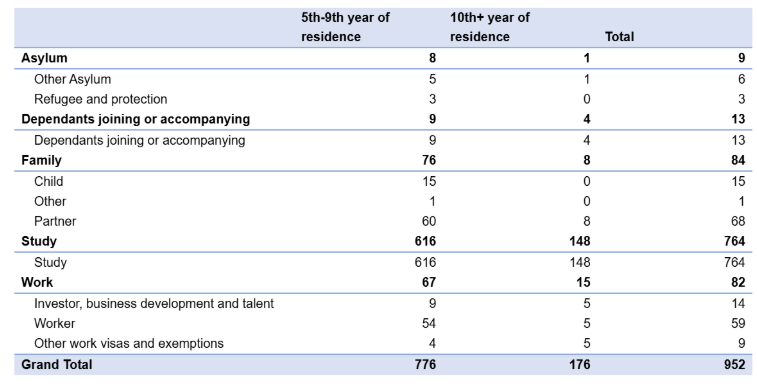
Source: Home Office Migrant journey 2025 report
Some people within this cohort switched to Ukraine Schemes to escape visas which tied them to difficult and even harmful situations. The UK-based Ukrainian organisations Opora and Ukrainian Voice UK and the migrant charity Settled have reported instances of bullying at work and redundancies causing people to leave work visas, while the breakdown of a marriage and domestic abuse have compelled others to leave family visas. In some of these cases, people were unaware that switching would break their route to securing Indefinite Leave to Remain.
Oksana Andriianova is a Business Travel Consultant who volunteers at Opora to help other Ukrainians rebuild their lives in the UK. She married a UK citizen in 2020 and spent time in the country on temporary visas until securing a family visa in 2022, which was ended two years later by the collapse of her marriage. Although she knew it would break her pathway to ILR, she had little choice but to switch to a Ukrainian Extension Scheme (UES) . But the temporary nature of this visa now places a great strain on her. She is unable to make plans in the UK beyond its three-year duration, and returning to Ukraine feels unrealistic.
“We are from Donbas, the territory is invaded, our homes are destroyed,” Oksana says. “My biggest worry is my [11-year-old] daughter, she’s already here for five years. She wouldn’t survive in Ukraine.”
Professor Sara Jones has documented the impact of visa insecurity on the lives of Ukrainians in the UK through the Ukraine Policy Network, a coalition of organisations led by academics at Birmingham University which advocates for greater support for those displaced by the war. The Network is calling on the government to provide clear pathways to settlement for both pre- and post-war arrivals.
Prof Jones says that as thousands of Ukrainians have now spent years in the UK since the conflict began, the notion that the schemes are temporary cannot hold. “The basic fairness principle that that time is not counted towards settlement doesn’t seem reasonable anymore,” she says, “[it] just exacerbates that sense of precarity.”
However, even if all those living in the UK under Ukraine Schemes were to gain pathways to settlement anytime soon, it appears the future would remain insecure for many. The Home Office’s newly updated overhaul of immigration rules affecting all immigrants under its “earned settlement” framework will extend the qualifying period for Indefinite Leave to Remain with retroactive effect, increasing the current default of 5 years to 10 years for most immigrants. For Mark, it appears he will have to wait until 2036 before he is eligible to make an application.
“I’ve been in this country 14 years and the whole time I was following the rules,” he says. “Even if you follow them to the T, you can’t be sure that next year that’s going to count for anything.”
Read More: